My Kid Loves Drake But Their Teacher Keeps Assigning Mozart — Now What?
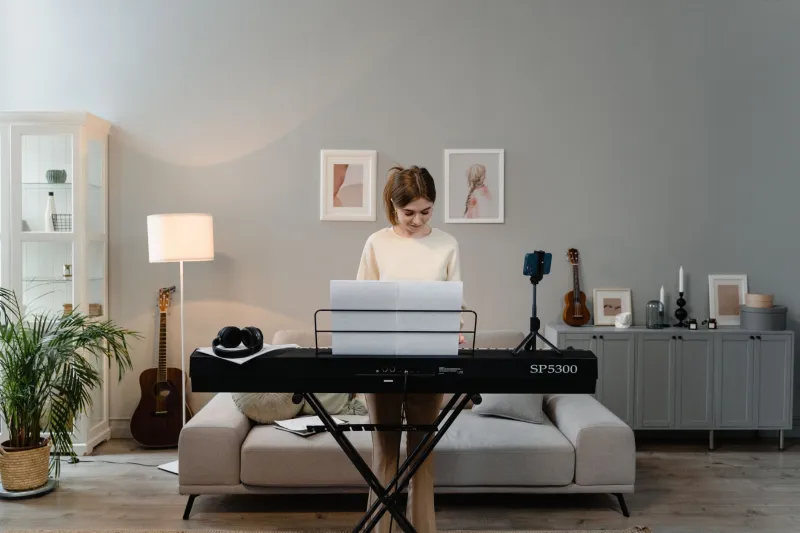
Picture this: your seventh-grader comes home buzzing after hearing a song on the radio. They sit down at the piano and start picking out the melody by ear, completely on their own. It's genuinely exciting. Then Tuesday rolls around, and they're back to scales and a Clementi sonatina — and suddenly that spark is nowhere to be found.
If you're a music parent in Katy, you've probably lived some version of this story. The gap between what kids love listening to and what they're assigned to practice can feel enormous. And if you're not careful, that gap can quietly erode motivation until lessons become just another chore on the calendar.
But here's the thing: this tension doesn't have to be a standoff. In fact, when it's handled well, it can become one of the most powerful forces in a young musician's development.
Why Classical Training Gets a Bad Rap (and Why It Doesn't Deserve It)
Let's be honest — classical repertoire has an image problem with a lot of kids. It can feel stuffy, distant, and completely disconnected from the music they actually care about. That's not a flaw in the music itself; it's a framing problem.
The techniques embedded in classical training — proper hand position, dynamic control, sight-reading, understanding harmonic structure — are genuinely transferable to every genre imaginable. The same finger independence that makes a Bach invention feel manageable is what helps a guitarist nail a complex chord melody. The breath support a classical vocalist builds is exactly what a pop singer needs to hold a phrase without cracking.
So the goal isn't to make your child love Beethoven. It's to help them understand that Beethoven is a tool, not a destination.
The Real Problem: When Lessons Feel Like a Different Language
Here's where things get tricky. A lot of traditional lesson structures weren't designed with genre diversity in mind. Many instructors — especially those trained in conservatory settings — were taught to follow a specific curriculum path, and deviating from it can feel risky or even unprofessional.
But students who feel like their musical identity is being ignored don't just lose interest in classical music. They lose interest in music altogether.
When a kid who's obsessed with Tyler, the Creator or Olivia Rodrigo sits through lesson after lesson without any acknowledgment of what they actually love, the message they receive — even if it's unintentional — is that their taste doesn't count. That's a hard thing to come back from.
Practical Ways to Close the Gap
The good news is that there are real, workable strategies for honoring both rigorous technique and genuine musical passion. None of them require abandoning structure — they just require a little creativity.
Talk to the instructor directly. This sounds obvious, but a lot of parents assume the teacher has a fixed plan and there's no room to negotiate. Most good instructors are more flexible than their syllabi suggest. Ask whether there's space in the lesson to incorporate one piece per month that your child actually chose. Frame it as motivation support, not a criticism of their teaching approach.
Use pop songs as a technical workout. A lot of contemporary music is deceptively challenging to play well. Ask the teacher to analyze a song your child loves and identify what skills it requires. Chances are, those skills overlap significantly with what's already being taught. Suddenly, the classical exercises have a context that feels relevant.
Let your child lead one part of the practice session. Even fifteen minutes of free exploration — where they're playing whatever they want, however they want — can completely reset their attitude toward the structured portion of practice. It signals that music is a space for self-expression, not just compliance.
Look for teachers who already blend genres. In a music community as active as Katy's, there are instructors who specialize in exactly this kind of approach. If your child's current teacher isn't a good fit for their musical identity, that's worth addressing sooner rather than later. A great teacher for one student isn't automatically the right teacher for every student.
What Genre Diversity Actually Does for Young Musicians
Here's something music educators have known for a while but don't always say loudly enough: students who engage with multiple genres tend to develop a more flexible musical ear. They're better at improvising, better at playing by ear, and often more confident performers because they're not just executing a score — they're interpreting music they have genuine feelings about.
A classical-only approach can produce technically precise musicians who freeze the moment they're asked to do something outside the page. A genre-diverse approach, grounded in solid technique, tends to produce musicians who can adapt — which is exactly what the modern music world rewards.
Playing hip-hop rhythms doesn't weaken a student's sense of classical phrasing. Learning a rock power chord doesn't make their legato worse. If anything, the contrast sharpens their awareness of what makes each style distinct.
A Note for Katy Parents Specifically
Katy is a community with serious musical energy. Between the school programs, the local performance opportunities, and the sheer variety of families here, there's no shortage of kids who are deeply passionate about music — just not always the music their lesson books contain.
That passion is the most valuable thing your child brings to their musical education. It's worth protecting. And the best way to protect it isn't to choose between classical training and contemporary taste — it's to find an instructor and a structure that treats both as legitimate parts of the same journey.
Every note your kid plays, whether it's a Bach prelude or a Billie Eilish cover, is part of the story they're building as a musician. The goal is to make sure that story keeps moving forward — and that they actually want to keep telling it.
If you're navigating this exact tension right now, you're not alone. And you don't have to pick a side.